The Nakatomi Plaza Experiment
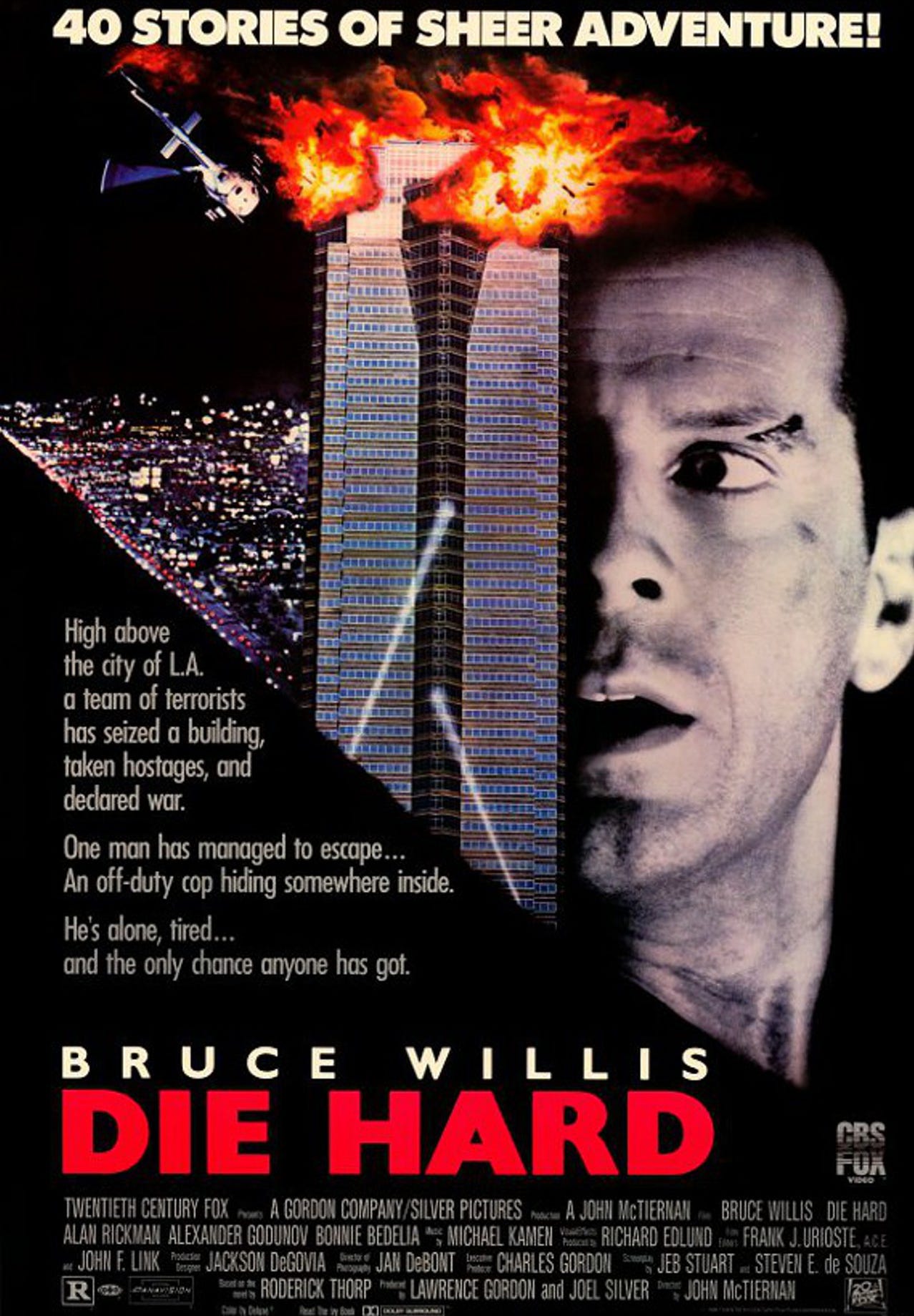
I recently had the privilege of providing a key note to the MITOTI Workshop. There were some amazing presentations and some fascinating research. The conference covered the convergence of IT (Information Technology) systems and OT (Operating Technology) systems. OT systems are essentially cyber-physical systems, controlling manufacturing equipment, smart buildings, city infrastructure etc.
Probably the most exciting session for me, and I hope for many at the end of the conference was the last session, it was a true workshop style collaboration. We got together around a white board, trying to sketch out what the future might bring.
Trying to break out of the current mode of thinking, and opening up the imagination is hard. We often just default back to our own assumptions. To imagine the future, we have to swap our assumptions for new ones. That’s tough, particularly if you have spent years researching a particular topic of direction.
What came out though, was something I’d like to call the Nakatomi Plaza Experiment.
Future Ideas will Die Hard
The “Christmas” movie Die Hard is a 1980’s classic. In this movie, John McClane a New York cop flies across the country to Los Angeles to attempt to repair his relationship with his estranged wife. His wife has a new job working for a large Japanese conglomerate “Nakatomi” who has recently built their new America HQ in a tower block, called Nakatomi Plaza. For some unknown reason the company keeps a large amount of money in a computerized vault in the building, and a German master criminal, Hans Gruber is intent on stealing it. What follows is an action movie where John McClane takes on the gang of criminals run by Hans Gruber. The building plays a central role.
The Nakatomi Plaza experiment
This experiment is to reconsider the movie and the events that happen using modern or future building and power control systems. The building itself plays a huge role in the original movie, and the characters do interact with it and its control systems in number of ways which would be different, or pose different challenges today, for instance (Spoiler Alert):
- The criminal gang takes control of the security system of the building, by shooting the security guards, there is no other protection on the system other than a set of keys - no passwords.
- The criminal gang disconnects the building from external phone lines by physically cutting the cables - there is no 4G / 5G backup system for the building control or fire system.
- McClane uses the fire control system, setting off a fire to trigger an emergency response.
- The lifts (elevators) are used and semi automated by both sides.
- Fire and explosions take our entire floors and parts of the building.
- The criminals need the power to be cut to the building and are waiting for the FBI to do this, apparently this helps them unlock a vault.
These are just a few of the events which involve the building, its security, power and control systems. But it raises questions; what would happen in a future building system, or even in a modern state of the art system?
I have hinted about some possible angles in the bullets above, but there is much more to think and to imagine about. It was a heck of a fun way to start thinking creatively about what might be in the future, for instance:
- How would an AI system deal with loss of a part of the building, would it be a distributed control system and an AI stack able to respond, and work in separate systems?
- Could a camera based security system automatically detect the fire arms used by the criminal gang?
- What would the criminal gang now need to do to get access to the building control system? - Could this be detected, would remote access to be available, could another user remotely take control of the building? Would the gang even need to physically enter the building at all?
- Could McClane and the criminal gang use the building control systems against each other? - Could the build system detect these unusual requests?
- What would happen to the power systems in the building, they should get disrupted by explosions, etc. Is there per floor battery back ups? Backup generators? Solar battery systems? Etc?
It was so much fun to start the mental experiment, and to get us all thinking a little bit outside of the box. There just didn’t feel like there was enough time to explore the whole thought experiment, but anyway - that would be a fun thing to carry forward into the new year.
“Yippie Kay-Yay” and Happy New Year !
Die Hard the movie, and the movie poster used here are (c) 1988 Twentieth Century Fox Film Corporation, the Move poster is reproduced here under fair use, to illustrate the movie only.
Note: You know you are feeling old when you have to explain the plot of Die Hard. I guess to my generation this was a common cultural reference from the 1980s.